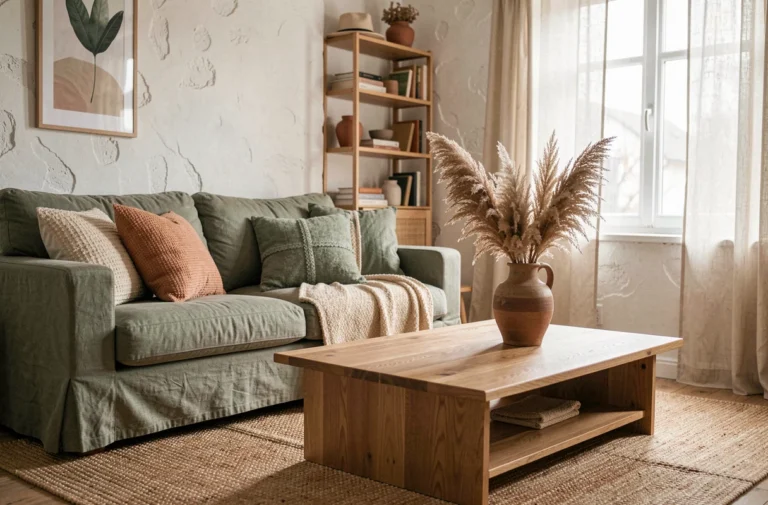
A decorative piece of furniture should not be chosen solely based on a visual impulse. The internal structure, the chemical composition of textiles, the dimensional compatibility with the room, and the ability to repair determine the relevance of a purchase far more than current trends.
Repairability and internal structure: what distinguishes a durable decorative piece
The visible surface of a piece of furniture, whether it’s a console, a coffee table, or a shelf, does not indicate its actual longevity. We recommend systematically checking three points before any purchase: the availability of spare parts, access to disassembly instructions, and the possibility of replacing a fabric or padding.
A piece of equipment whose internal structure relies on standardized components can be repaired and adapted over time. A sofa with a seat stapled to a thin monobloc frame will end up in the landfill at the first snag. A model with a zip-off cover and replaceable straps will remain functional for several more years.
This logic also applies to accessories. A light fixture with soldered wiring cannot be repaired. A lampshade attached by a clip or screw system allows for quick replacement. Before browsing the equipment available at C Ma Déco, we suggest making a list of items that need renewal and assessing the repairability of each targeted element.
Environmental labeling of decorative textiles in France
Since October 1, 2025, textile environmental labeling can be used within a regulated framework. Starting October 1, 2026, brands communicating on an environmental indicator will need to associate it with the official environmental cost, under certain size and sales volume conditions.
For decoration, this directly concerns cushions, curtains, throws, covers, and tablecloths. Comparing two decorative textiles based on their official environmental cost becomes a relevant reflex, just like price comparison.
The label “indoor air emissions” (rated from A+ to C) covers paints, varnishes, glues, and floor coverings. However, particle board furniture, certain foams, and textiles are not uniformly covered by this system. A fiberboard chair may emit formaldehyde without the mandatory label indicating it.
PFAS in upholstery fabrics: a discreet trap
Stain-resistant treatments applied to many upholstery textiles still rely on PFAS (per- and polyfluoroalkyl substances), which are gradually being banned. Choosing untreated textiles or those with recognized certification protects both indoor air quality and long-term usability. A certified fabric may sometimes cost slightly more, but it won’t risk becoming non-compliant in a few years.
Color palette and proportions: calibrating equipment to the room
The coherence of an interior relies less on the chosen style than on the relationship between volumes and colors. We regularly observe sizing errors: a rug that is too small under a dining table, a monumental vase on a narrow console, curtains that stop mid-calf.
The operational rule is simple: each decorative accessory must respect the scale of the surrounding furniture. A cushion placed on a three-seater sofa should not exceed a quarter of the seat width. A painting hung above a sideboard should cover between half and two-thirds of its length.
For the palette, limiting the dominant colors to three in the same room remains the most reliable method. This does not mean three colors in total, but three tonal families that structure the space:
- A neutral dominant (walls, floor, large furniture) that occupies the majority of the visible surface.
- A secondary color (textiles, seating, curtains) that adds personality without overwhelming the eye.
- An accent color (decorative objects, wall art, small furniture) that creates focal points, in limited quantity.

Table, living room, dining room: adapting equipment by zone
A common mistake is to decorate each room independently. A coherent interior addresses the visual flow between spaces. If the living room adopts warm tones and the dining room cool tones, the transition will be jarring.
For open spaces, reusing at least one material or shade from one area to another is enough to unify the whole. A linen throw in the living room and linen napkins on the dining table create a subtle yet effective thread.
Selection of decorative accessories: concrete sorting criteria
Accumulation remains the most common flaw. Three well-placed objects are worth more than ten scattered pieces. Before adding an item, we systematically ask two questions: does this object serve a function (even if just visually, like a focal point)? And would its removal truly impoverish the room?
The selection criteria to apply for each accessory:
- Material compatible with the actual maintenance of the room (velvet in a dining room with children poses a predictable problem).
- Dimensions checked against the support (measure before buying, not after).
- Finishing consistency with existing furniture (brushed brass does not easily coexist with polished chrome).
- Traceable origin and composition, especially for textiles and scented candles that emit compounds into indoor air.
A final often-overlooked point: natural light radically alters the perception of colors. A fabric chosen in-store under artificial lighting may appear dull or too bright once placed at home. Testing a sample in the relevant room, at different times, remains the only reliable method.
The most successful decorative equipment is that which is forgotten. It structures the space, supports daily uses, and does not require constant attention. Focusing on manufacturing quality, repairability, and environmental compatibility ensures an interior that ages well, without needing complete renewal each season.