Creative activities are not just about keeping hands busy. They engage specific cognitive skills (planning, sequencing, fine motor skills) and produce measurable effects on emotional regulation. Since the post-Covid period, we have observed a profound reshaping of practices, with a shift towards intergenerational formats and therapeutic uses that change the game for the sector.
Creative activities in care pathways: an underestimated therapeutic use
Art workshops, collage, creative journaling, or sewing are now integrated into cognitive remediation and post-cancer reconstruction programs. Day hospitals, cancer leagues, mental health associations: the structures that prescribe or recommend these practices are multiplying.
What distinguishes these workshops from traditional leisure activities is their framework. The choice of materials, the duration of the sessions, and the progression of actions are calibrated to meet a specific objective: stress management, recovery of fine motor skills, or restructuring self-esteem. Patchwork, for example, combines spatial planning, cutting, and assembly according to a sequence that engages working memory.
Free painting, often offered post-cancer, operates on a different level. The absence of formal instructions allows the participant to regain a form of agency over their production, after a period when the body has been medicalized. These non-drug therapeutic tools do not replace treatment, but feedback published by social and medical structures confirms their value in a holistic journey.
Intergenerational workshops: painting, puzzles, and social connections in libraries
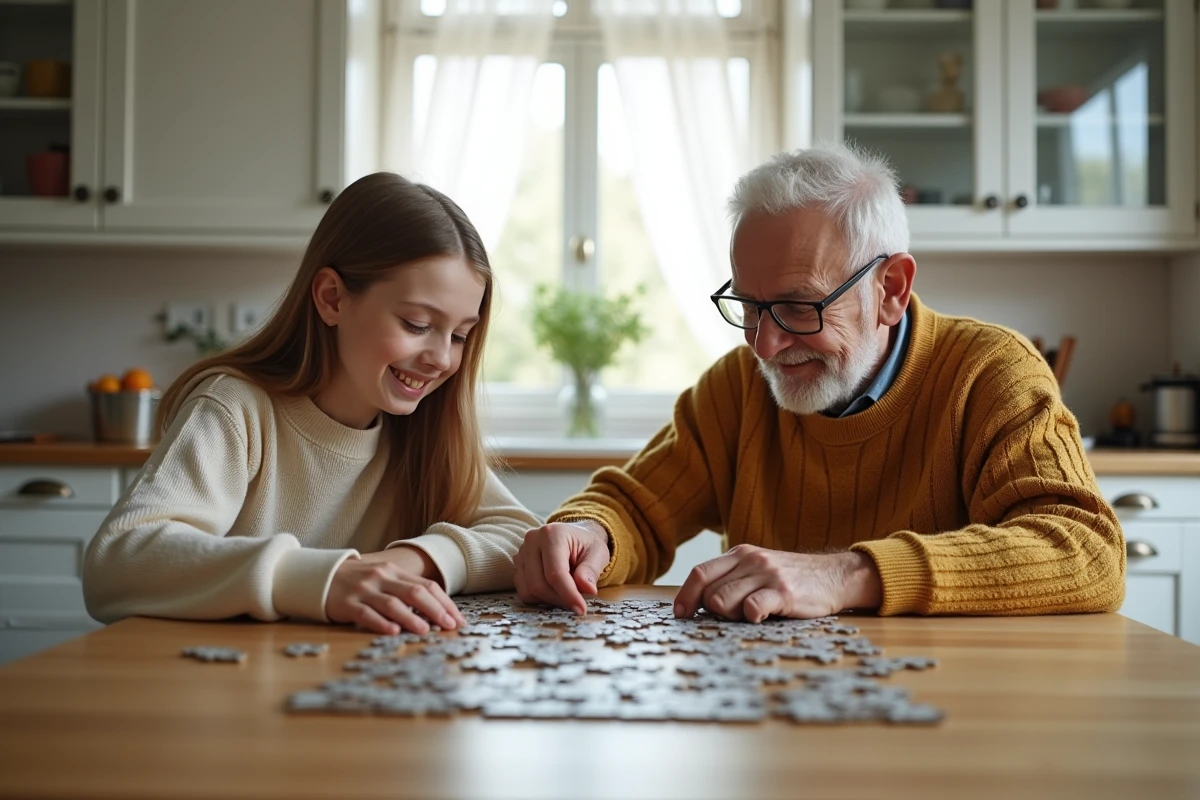
Bringing together children, parents, and seniors around the same creation table produces an effect that age-segmented leisure does not generate. Libraries, nursing homes, and community centers are developing intergenerational creative workshops as a lever to prevent isolation, particularly among the elderly.
The format works because it removes the hierarchy of skill. A six-year-old can master collage just as well as an adult. A senior brings patience and precision that younger ones have yet to develop. The collective project becomes the neutral ground where each participant contributes without a subordinate relationship.
We recommend prioritizing materials that tolerate mistakes: modular origami, mosaic, collaborative puzzle assembly. These hands-on activities accept revisions and adjustments without frustration. Among the leisure activities on Comptoir d’Encre, several categories cover this type of practice suitable for all ages.
Collaborative puzzle: a format too often confined to solo
The large puzzle, worked on by several people over multiple sessions, creates a project dynamic. Each participant identifies an area, sorts pieces, negotiates connections with their neighbors. This is not passive entertainment: it is applied spatial coordination.
The structures that organize these workshops find that intergenerational puzzles generate more verbal exchanges than free painting, precisely because they require communication about sorting and assembly strategies.
DIY manual activities at home: choosing the right level of constraint
The majority of creative kits sold online target children, with a high level of guidance (pre-cut templates, step-by-step instructions). This format reassures parents but limits learning. An overly guided kit produces a uniform result and eliminates decision-making, which is precisely what creative activity is supposed to develop.
For children aged five and up, we recommend activities with partial constraints:
- Free support painting with a palette limited to three colors, which forces mixing and chromatic experimentation without overwhelming
- Simple sewing on pre-cut felt but without a prescribed model, allowing for choices in assembly and pattern
- Making thread bracelets with a basic scheme, then free variations once the technique is mastered
For adults who want to go beyond the kit stage, scrapbooking or creative journaling offer a structuring framework (notebook format, page theme) while allowing total freedom in composition. Modular origami, which involves assembling dozens of identical modules into a three-dimensional structure, combines meditative repetition with a spectacular result.
Painting and textile art: two families of creative activities with distinct cognitive effects
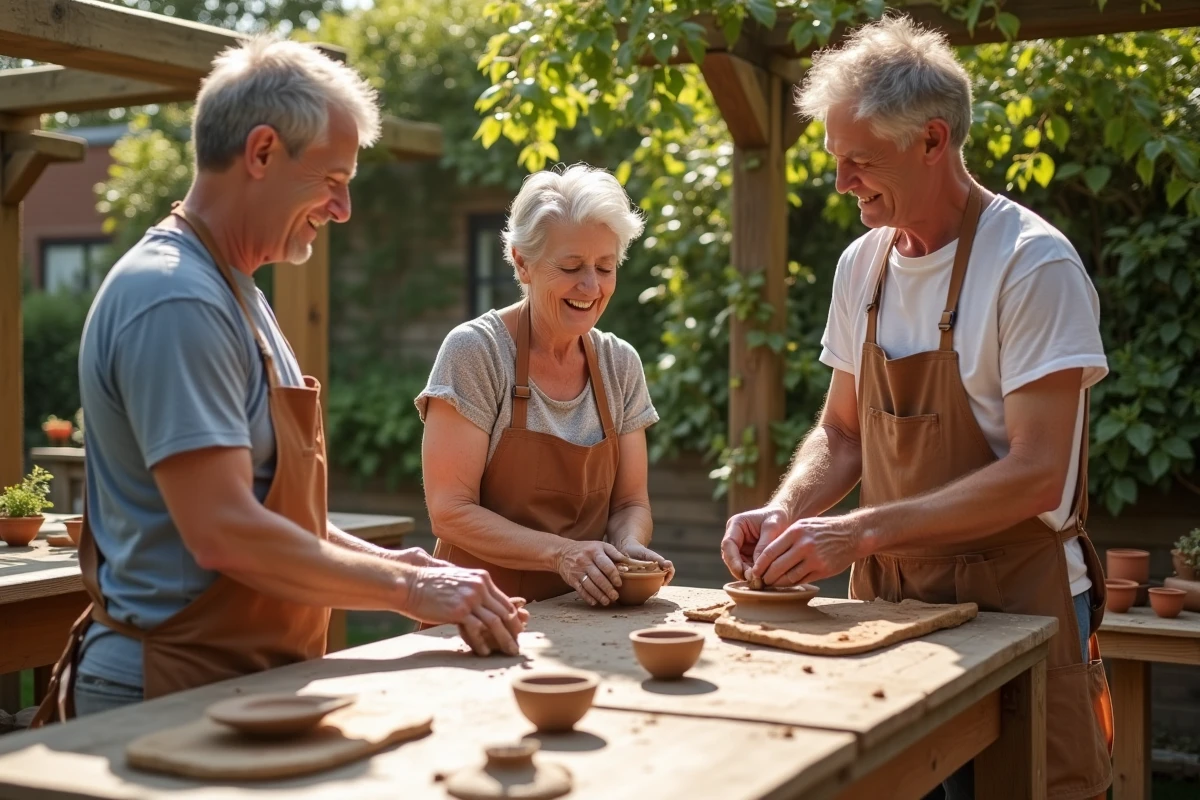
Grouping all creative activities under the same label masks functional differences. Painting (acrylic, watercolor, gouache) primarily engages eye-hand coordination, space management, and tolerance for the unpredictable (the pigment that runs, the water that overflows). It suits profiles that need to let go of control.
Textile art (sewing, embroidery, weaving, patchwork) relies on an inverse logic: rigorous sequencing, anticipation of steps, and precision of action. These activities are better suited for individuals seeking structure, including in contexts of stress management or burnout.
This distinction has practical implications for anyone organizing workshops in families or institutions. Offering free painting to someone who needs structure produces anxiety, not relaxation. Offering counted embroidery to a four-year-old generates frustration.
Selection criteria according to context
- In families with mixed ages: prioritize collage, puzzles, or mosaics, which tolerate varying skill levels on the same project
- Solo for stress management: structured textile art (embroidery, weaving on a small loom) or repetitive folding origami
- In adult collective workshops: long-term collaborative projects (mural, collective patchwork) that maintain engagement over several sessions
- For children working independently: kits with partial constraints, with technical support but without a model to reproduce exactly
The choice of a creative activity should be framed as a question of cognitive compatibility rather than taste. A well-calibrated workshop, suited to the audience and context, produces lasting engagement. A poorly targeted workshop, even with high-quality materials, will be abandoned after the first session.