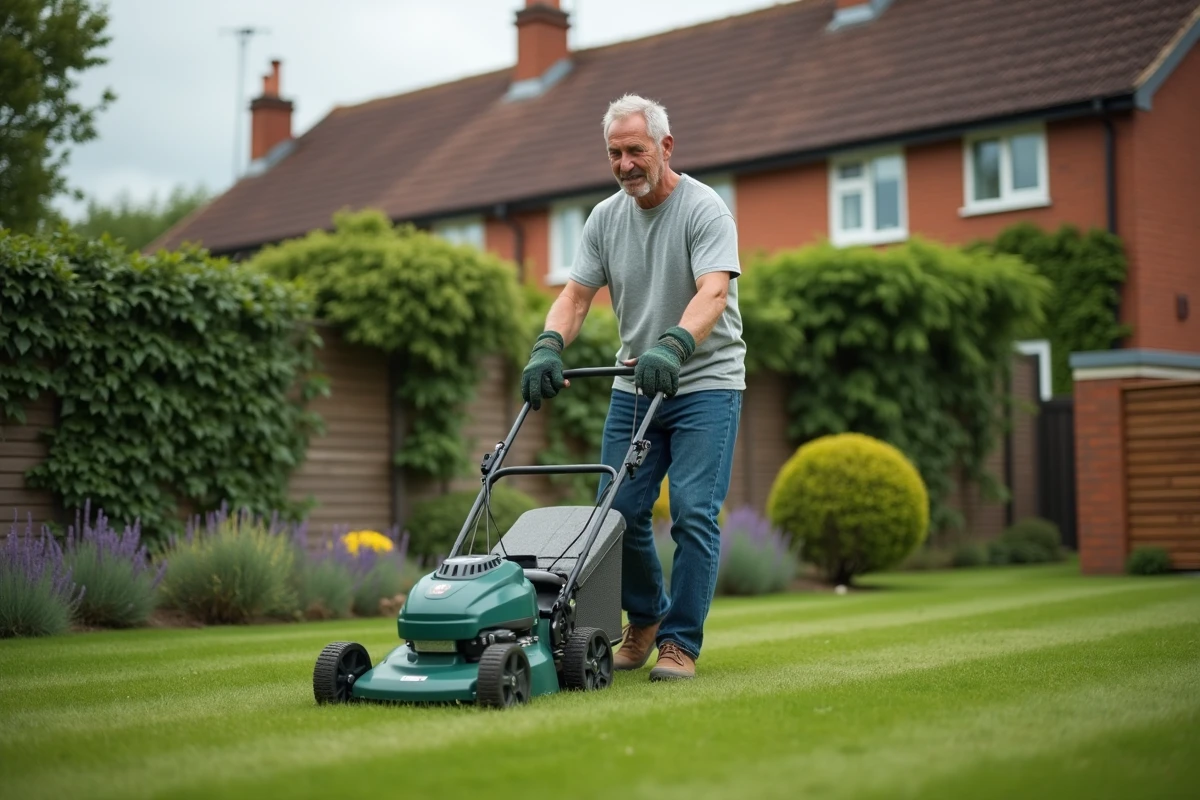
The market for electric mowers has transformed in recent years with the arrival of interchangeable battery platforms and enhanced safety standards. For a buyer, the choice is no longer limited to motor power or cutting width. Several technical parameters, sometimes absent from product sheets, deserve examination before checking out. Here’s what classic guides often overlook.
Interchangeable Batteries: What the Tool Ecosystem Really Changes
Since 2023, Bosch (with the 18V Power for All Alliance platform), Ryobi (ONE+ System), Ego, and Stihl offer batteries compatible with multiple garden tools. In practice, this means that a battery purchased for a drill can power the mower, hedge trimmer, or blower from the same range.
The economic interest is direct: buying a “bare” mower, without battery or charger, significantly reduces the cost of equipping a complete garden. Before comparing displayed prices, check if you already own compatible batteries. This is often the criterion that tips the value-for-money ratio of one model compared to another.
Several comparisons referenced on tondeuse-electrique.net detail the compatibilities between platforms and models sold without batteries, making it easier to sort when already equipped with a brand.
However, not all batteries from the same manufacturer are equal. A low-capacity battery will suit a small area but will struggle on a larger surface. Voltage and amp-hour ratings remain indicators to cross-reference with the actual area to be mowed.

Actual Noise Level of Electric Mowers: A Documented Discrepancy
A recurring selling point for battery mowers is their low noise level. Product sheets display values that seem reassuring, but independent tests conducted since 2024 reveal a gap. The actual noise level sometimes exceeds the advertised value by more than 5 dB(A), which is significant.
Five decibels more is a perceptible difference to the ear. In densely populated residential areas, this can pose a neighborly issue, especially during mowing at the end of the day or on weekend mornings. Field feedback varies on this point: some users do not perceive the nuisance, while others find their electric mower louder than expected.
To verify, look for independent laboratory measurements rather than manufacturer data. Test results published by consumer associations are often more reliable than marketing sheets.
Safety of Electric Mowers: Features to Check Before Purchase
The EN 60335-2-77 standard, updated in 2023, regulates electric garden devices and pushes manufacturers to integrate more comprehensive safety features. Recent ranges from Gardena (PowerMax 2024) and Stihl (RMA series 2023-2024) include systems that are still not prominently featured in public communication.
Here are the safety features to look for in an electric mower:
- Double start control, which prevents accidental starting by a child or during unintentional handling.
- Removable key or lock code, allowing the machine to be neutralized when stored in an accessible shed.
- Automatic stop sensor in case of grip release, which cuts the blade in a fraction of a second.
- Lock button separate from the start button, adding a deliberate step before any activation.
These features are not standard on all models, even in mid-range price categories. Check the detailed technical sheet and not just the commercial summary.
Why Communication Remains Discreet on These Points
Brands prefer to highlight power, autonomy, or design. Safety, perceived as an anxiety-inducing topic, is relegated to the bottom of the page. Yet it is a decisive choice criterion for families with children or pets.

Wheels and Height Adjustment: The Recurring Weak Point of Cordless Mowers
Customer service feedback collected by major retailers since 2023 converges on a specific flaw in cordless electric mowers: wheels and height adjustment mechanisms deteriorate faster than on wired or gas models. This issue affects both entry-level and some mid-range models.
The reason is partially mechanical. Battery mowers, lighter to compensate for the weight of the battery itself, sometimes use less robust plastic parts for wheel axles and adjustment levers. After a few seasons, play in the wheels appears, cutting height becomes imprecise, and mowing quality suffers.
Before purchase, physically test the adjustment mechanism in-store. A lever that seems fragile or a centralized system entirely made of plastic are warning signs. Models equipped with metal bearings on the wheels and reinforced levers last better over time.
Wired or Battery Electric Mower: Concrete Choice Criteria
The question of the cord remains relevant for small areas. On a modest surface, a wired mower is cheaper and poses no autonomy issues. The constraint of the cable is real but manageable with an appropriate extension and an organized mowing circuit.
Conversely, on a terrain with obstacles (trees, flower beds, slopes), the battery provides a freedom of movement that enhances user comfort. The available data do not allow for a universal surface threshold to switch from one to the other, as terrain configuration matters as much as its area.
Here are some concrete criteria to decide:
- Simple and compact terrain: wired remains the most economical and mechanically reliable choice.
- Terrain with slopes or many obstacles: the battery avoids cable snags and facilitates maneuvering.
- You already own compatible batteries: the “bare” mower becomes financially advantageous.
The choice of an electric mower is not based on a single parameter. The ecosystem of batteries, verified noise levels, safety features, and the mechanical durability of wear parts form a whole to be evaluated collectively. Testing in-store, cross-referencing independent test results, and checking compatibility with your existing tools remains the safest method to avoid a disappointing purchase.