
Asphalting a yard is equivalent to waterproofing a surface. In urban planning law, this operation alters the exterior appearance of a property and affects the flow of rainwater. Depending on the municipality, the area concerned, and the proximity to public roads, the procedures range from a simple notification to the town hall to a prior declaration of work, or even a supplementary study.
Hydrological impact study: the new requirement for yards over 50 m²
Decree No. 2025-847 of October 12, 2025, amended the Urban Planning Code by imposing a hydrological impact study for any asphalting exceeding 50 m². Published in the Official Journal on October 13, 2025, this text aims to limit urban runoff and the risks of flooding related to the gradual waterproofing of private plots.
Specifically, this study must demonstrate that the project does not degrade rainwater management on the plot and downstream. It is attached to the prior declaration file submitted to the town hall. A specialized hydraulic or geotechnical study office prepares the document, which extends the preparation time for the file.
To obtain authorization to asphalt a yard of this size, it is necessary to anticipate this step well before contacting an earthmover. Without this document, the town hall will refuse the file.

Prior declaration of work: when the PLU conditions asphalting
The local urban plan (PLU) of the municipality sets the rules applicable to each plot. Some PLUs completely prohibit asphalt in residential areas, while others impose a minimum percentage of permeable surface per plot. Ignoring these regulations exposes one to a formal notice and the obligation to restore the land to its original state.
The prior declaration of work (Cerfa form No. 13703) remains the standard document for an asphalting project that alters the exterior appearance of a plot. The file includes a site plan, a mass plan, and a description of the proposed surface treatment.
Documents to gather before submission
- The site plan of the plot, downloadable from the online cadastre, which locates the land within the municipality.
- The scaled mass plan, indicating the area to be asphalted, property boundaries, and any connections to the rainwater network.
- The hydrological impact study if the area exceeds 50 m², in accordance with the 2025 decree.
- A descriptive notice specifying the type of surface treatment (hot mix, double layer) and the water management devices.
The instruction period is generally one month from the complete submission. The town hall may extend this period if the land is located in a protected area (historical monument, classified site) or if documents are missing.
Road authorization: the case of yards adjacent to public domain
When the yard directly adjoins a municipal road or when the work requires access via public roads (passage of machinery, temporary storage of materials on the sidewalk), a road authorization is added to the prior declaration. This authorization falls under the town hall’s road service, not the urban planning service.
The road file specifies the dates of occupation, the footprint on the public domain, and the signage plan for the construction site. In large urban areas, this request should be submitted several weeks before the start of the work. Some municipalities charge for occupation rights.
The absence of road authorization constitutes a distinct offense from the absence of a prior declaration. Both sanctions can accumulate, which doubles the complications in case of inspection.
Permeable alternatives to asphalt: reducing procedures and runoff
The 2025 decree has mechanically reignited interest in permeable surfaces. Because they allow water to infiltrate, these materials reduce or eliminate the requirement for a hydrological impact study, while meeting the anti-runoff requirements of the strictest PLUs.
Stabilized gravel and cellular slabs
Cellular polypropylene slabs, filled with gravel or grassed soil, provide a drivable surface without waterproofing the ground. Resin-stabilized gravel works on the same principle: water passes through the surface and reaches the groundwater.
These solutions do not alter the impermeability coefficient of the land. In many municipalities, they are exempt from prior declaration if they do not significantly change the exterior appearance. Verification with the urban planning service remains necessary, but the file is lighter and the instruction faster.
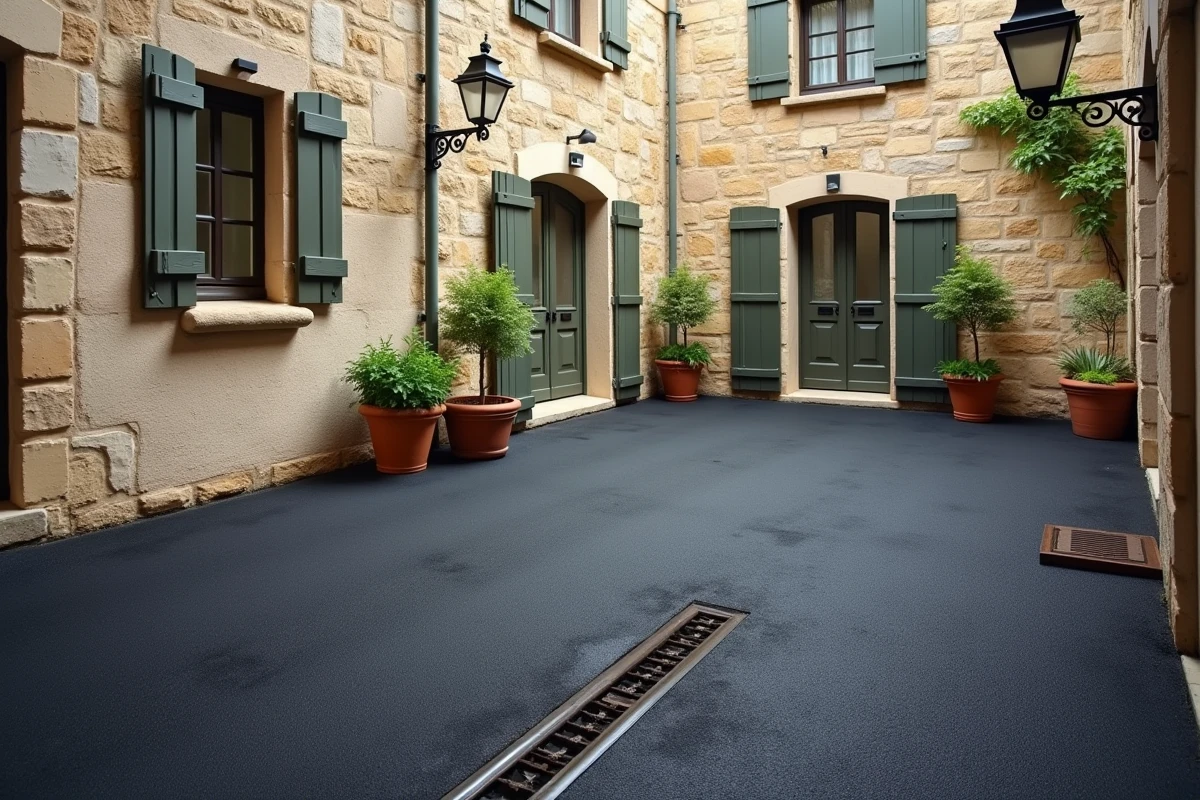
Permeable concrete and porous asphalt
Permeable concrete and porous asphalt fall between classic asphalt and fully permeable solutions. Their infiltration capacity depends on the formulation and implementation. Some PLUs accept them as permeable surfaces, while others do not.
The regulatory nuance is as follows: if the PLU classifies the surface as impermeable, the hydrological impact study remains required beyond 50 m², even for a so-called “draining” asphalt. Requesting written confirmation from the urban planning service before assembling the file avoids a late refusal.
Sanctions and regularization in case of asphalting without authorization
Asphalting carried out without a prior declaration constitutes a violation of the Urban Planning Code. The town hall can draw up a report and require the restoration of the land at the owner’s expense. The statute of limitations for initiating proceedings is six years from the completion of the work.
Regularization is possible: a posteriori prior declaration must be submitted, accompanied by the hydrological impact study if the area exceeds the threshold. The town hall is not obliged to accept this regularization, especially if the surface treatment violates the current PLU.
Before starting an asphalting project, the first useful step is to visit the urban planning service of the town hall with a scaled plan of the yard. This free consultation allows one to know precisely what file to prepare and whether a permeable surface could simplify the procedure.