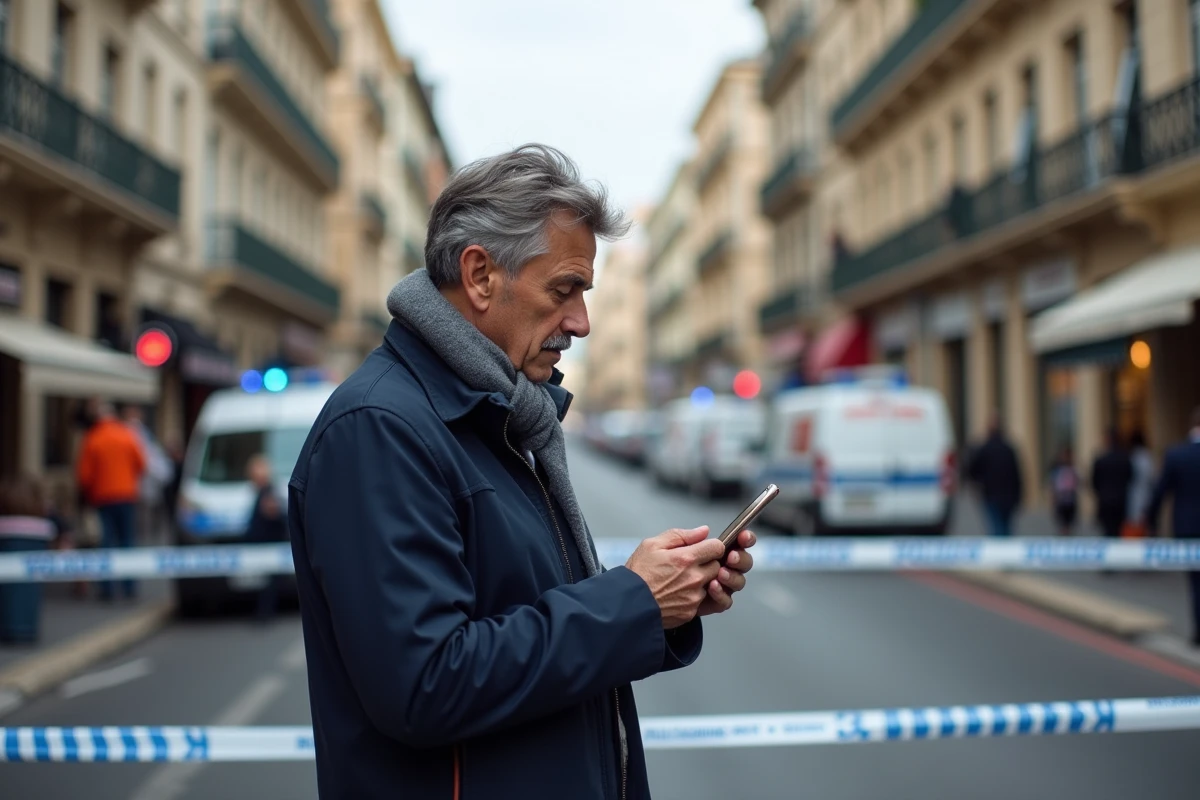
9:20 AM, a signal rises. And yet, no alert system is activated. The apparent calm masks an administrative mechanism that is slow to trigger. The authorities invoke complexity, a word that recurs like a refrain whenever it comes to coordinating local and national services. During security drills, this point is systematically brought to the table.
As the first hours pass, the Ministry of the Interior overturns the scenario. On the ground, the findings contradict the hypotheses made in haste. The case is handed over to the national anti-terrorist prosecutor’s office. The collected elements are already on the desks of specialized investigators, each piece of the puzzle transmitted as quickly as possible.
What the first images of the attack today in Cannes show
The footage captured by the surveillance cameras at the police station on Avenue de Grasse leaves no room for doubt. They unfold, minute by minute, the thread of the act. Lakhdar B., a determined figure, walks straight towards the police car. In a matter of seconds, the scene shifts: the door opens, the knife strikes, the response comes. The police officers are targeted without the slightest hesitation. One of them owes his safety to his bulletproof vest, which absorbs the shock at the heart of the operation.
Everything unfolds in a laboratory-like silence, captured by the cold lens of the cameras. The officers react without delay. The neutralization of the assailant occurs while the threat remains acute, preventing the attack from escalating dramatically. In the background, one can sense the rising tension: sirens, reinforcements, security barriers being set up at high speed.
Investigators scrutinize these images to reconstruct the exact sequence of the attack. Every detail, every hesitation, every gesture is dissected to shed light on the motivations and methods of Lakhdar B. This video material testifies to meticulous organization and, in reflection, to the responsiveness that helped avoid the worst on-site.
For those who want to gauge the reality of a terrorist attack in France, the first images of the attack in Cannes today provide a frontal view of the vulnerability of police officers and the speed of their response.
Attack and security: what responses to the threat?
After the knife attack in front of the Cannes police station, the question of security comes back to the forefront, acute and pressing. This episode reminds us how even reinforced measures remain exposed to a constantly evolving terrorist threat. The Vigipirate plan, adapted after the attack, was not enough to prevent a targeted offensive against law enforcement.
From the moment the facts were announced, the prefecture and the Ministry of the Interior increased patrols in Cannes, as well as in Nice and Paris. RAID teams quickly intervene at Lakhdar B.’s home, searching for clues about the preparation of his act. Outside, the police presence is massive, visible, but also more discreet thanks to the surveillance cameras sweeping the area.
The institutional response also affects the Cannes Film Festival, which interrupts its activities and mobilizes local elected officials. David Lisnard, the mayor of the city, as well as Éric Ciotti and Renaud Muselier, express their solidarity with the officers. The context, marked by the precedents in Nice and Paris, raises questions about the actual effectiveness of the measures in place.
Here are the action points highlighted in the wake of the attack:
- Strengthening the Vigipirate plan
- Increased mobilization of police forces
- Adaptation of urban security schemes
The ability of police officers to stop the assailant, protected by their bulletproof vests, invites questions about the training and equipment available in the territory. The precedents of Manchester, Nice, or Paris have already shown that adaptation must be constant. The response is built every day, both on the ground and in the debates that stir the public sphere.

Justice, investigations, and debates: the issues raised by the Cannes attack
The judicial handling of the attack in front of the Cannes police station is organized according to well-established protocols. The Grasse prosecutor’s office opens the investigation, while the national anti-terrorist prosecutor’s office takes over in observation: the context and nature of the act are examined in detail. The criminal brigade of the Nice judicial police and the zonal judicial police department of Marseille move step by step, reconstructing Lakhdar B.’s path and the meticulous unfolding of the attack.
The first images extracted from the surveillance footage show the swiftness of the assault and the immediate reaction of the police officers, whose individual protection played a decisive role. Justice must now qualify the facts: isolated attack or planned act? The debate remains open, with the terrorist context weighing on every stage of the investigation.
Throughout the procedure, victims, police unions, and citizens follow each advancement. The demand for transparency and efficiency weighs on the justice system, which relies on the experience of its teams to bring the truth to light. In Cannes, as during major terrorism trials, the debate also focuses on penalties, monitoring of perpetrators, and support for victims. Society scrutinizes every decision, aware that security is not only played out on the ground but also in the balance between justice, rights, and collective vigilance.